AI Receptionist vs Answering Service: Which Is Right for Your Business?
AI receptionist vs answering service: how they compare on cost, availability, booking and handling the unexpected, when each one fits, and how to use both.
 By Saad Ali, founder of Agentyra AI
When a small business can't answer every call, there are two common ways to get help: hire a live answering service, or set up an AI receptionist. Both promise that no caller hears endless ringing. They work very differently, though, and the right choice depends on what your callers need, how many calls you get and how much judgment each call requires. This guide compares an AI receptionist vs an answering service side by side, so you can decide which fits, or whether you need both.
What is the difference between an AI receptionist and an answering service?
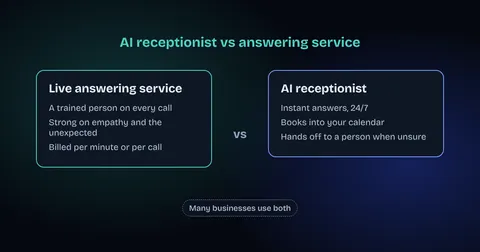
A live answering service is a team of trained people, usually at a call center, who answer your calls with your business name, follow a script you provide, take messages and sometimes book appointments. An AI receptionist is software that answers calls with a natural-sounding voice, understands what the caller says, and can answer questions, book into your calendar and send you a summary.
The short version: an answering service gives every caller a real person who knows a little about your business. An AI receptionist gives every caller an instant answer from something that can know a lot about your business, as long as it has been set up and tested properly. Our guide to what an AI agent is explains how the AI side works.
How do they compare side by side?
Here is how the two usually compare for a small service business. Individual providers vary, so treat this as a starting point and check the details with any provider you consider.
| Live answering service | AI receptionist | |
|---|---|---|
| Who answers | A trained person working from your script | Software with a natural-sounding voice |
| Availability | Depends on the plan; many offer 24/7 | 24/7, and it can answer several calls at once |
| Knowledge of your business | Limited to the script and notes you provide | Can answer from your services, hours, prices and policies |
| Booking | Often possible, depending on the plan and your calendar | Books directly into your calendar if connected |
| Handling the unexpected | Strong: people improvise and show empathy | Weaker: it should hand off when unsure |
| How you usually pay | Per minute or per call, often with a monthly plan | Monthly fee, sometimes plus usage; setup varies |
| Setup effort | A script and call-handling instructions | Your information, rules, testing and integrations |
| Busy periods | Can mean hold times if many calls arrive at once | Handles call spikes without queues |
When is a live answering service the better choice?
Choose a live answering service when your calls often need empathy, judgment or improvisation, or when callers expect to speak to a person every time. Emotional or sensitive calls, complicated questions that don't follow a pattern, and callers who strongly prefer people are all good reasons.
Customer preference matters here. In a Gartner survey, 64% of customers said they would prefer companies didn't use AI for customer service, and their top concern was that it would become harder to reach a person. If your callers fit that description, a person on the line may be worth the higher cost per call.
When is an AI receptionist the better choice?
Choose an AI receptionist when most of your calls are routine: booking, rescheduling, opening hours, service areas, published prices and basic triage. It also suits businesses whose calls arrive in spikes, such as the first cold morning for a heating company, because it can answer many calls at the same time.
An AI receptionist is only as good as its setup. It needs accurate information, clear rules about what it may say, testing with real calls, and an easy way for any caller to reach a person. Our guide on how to launch an AI call agent walks through that process step by step.
Can you use both?
Yes, and many businesses do. A common setup is an AI receptionist that answers every call first, handles routine requests on its own and transfers anything urgent, sensitive or confusing to a person, whether that's your own team during business hours or a live answering service after hours.
This combination gives callers an instant answer for simple requests and a human for everything else. It also keeps answering-service minutes for the calls that actually need a person.
What should you ask before choosing?
Before signing with any provider, AI or human, ask the same questions and compare the answers in writing:
- What happens when a caller asks for a person? How fast, and to whom?
- How are urgent calls handled? Can it reach someone on call immediately?
- What information will it use? Can you review and change the script or knowledge at any time?
- Does it connect to your calendar and CRM? Or will someone retype every message?
- What do you receive after each call? A summary, a recording, a transcript?
- How is it billed? Per minute, per call, monthly, or a mix, and what happens in a busy month?
- Can you test it first? Call it yourself with your ten most common questions before going live.
Where should a person stay in charge?
Whichever option you choose, decide in advance which calls must reach a person: emergencies, complaints, upset callers, pricing exceptions, and anything medical, legal or financial. Write those rules down and test them before launch.
It's also good practice to tell callers when they're speaking with an AI and to make reaching a person easy at every step. Rules about automated calls and recordings differ by country and industry, so check the ones that apply to your business.
How do you measure which one works?
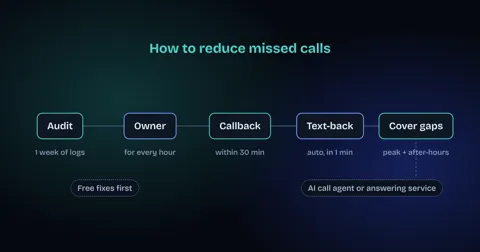
Run a one-month trial and compare the same numbers you tracked before: missed-call rate, calls answered after hours, bookings from phone calls, the share of calls handed to a person, and callback complaints. Our guide to how to reduce missed calls explains how to run the baseline audit.
If you're unsure, start with the cheapest fixes for missed calls, then trial one option on after-hours calls only, where the difference is easiest to see.
Want help choosing?
We build AI call agents for service businesses with a human handoff built in, and we'll tell you honestly if a live answering service fits your calls better. Book a free strategy call and we'll look at your call patterns with you.