How to Reduce Missed Calls: 5 Fixes for Small Businesses
How to reduce missed calls in a small business: run a one-week missed-call audit, then five fixes in order of cost, from call routing to AI call agents.
 By Saad Ali, founder of Agentyra AI
Every missed call is a small decision made for you: the caller tries the next business on the list. For service businesses, those calls are often the most valuable ones, because someone who picks up the phone usually needs help now. This guide covers how to reduce missed calls in a small business: why they happen, how to measure them in a week, and five fixes in order of cost, starting with the ones that need no new software at all.
Why do small businesses miss so many calls?
Small businesses rarely miss calls because nobody cares. They miss them because the people who could answer are busy doing the work: on a job, with a patient, in court or with another customer. Calls also cluster at the worst moments, such as early mornings, lunch, the end of the day and weekends.
The numbers are bigger than most owners expect. CallRail's 2025 small business benchmark, based on 1.1 million conversations, found that healthcare businesses missed 32% of their calls, legal firms 28% and home-services businesses 14%. The same release notes that up to 85% of customers whose calls go unanswered won't call back. A missed call is usually a lost customer, not a delayed one.
How do you find out how many calls you miss?
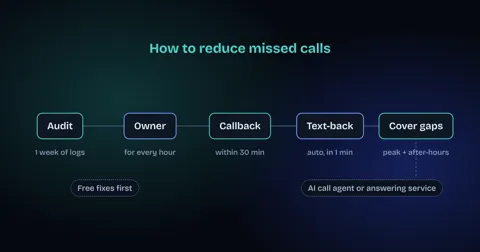
Run a one-week missed-call audit. Export the last seven days of call history from your phone system or provider and count three things: calls that weren't answered, calls that came in outside business hours, and how many of those got a callback the same day.
Then look at the pattern. Write down the hour and day of each missed call. Most businesses find their misses aren't random: they bunch up around lunch, the first hour of the day, the last hour, Saturdays, or whenever the one person who answers the phone is busy. That pattern tells you which fix to start with.
| What to count | Where to find it | Why it matters |
|---|---|---|
| Missed calls per day | Phone system call log | Your baseline, before any changes |
| Missed calls by hour | Call log, grouped by time | Shows the gaps you need to cover |
| After-hours calls | Calls outside your opening hours | Shows whether evening and weekend cover is worth it |
| Same-day callbacks | Outbound calls matched to missed ones | Shows how many missed callers you win back |
Fix 1: Give every call an owner
Decide who answers the phone at every hour of the business day, and route calls to that person. Many missed calls happen because everyone assumes someone else will pick up.
Most business phone systems let you set call routing by time of day, ring several phones at once, or forward to a mobile after a few rings. Set it up once, write the schedule down, and update it when people are on leave. This fix usually costs nothing.
Fix 2: Set a callback standard
Agree a rule for every missed call, such as a callback within 30 minutes during business hours and first thing the next morning after hours, and make one person responsible for it each day.
A written standard turns "we'll call them back" into something you can check. At the end of each week, compare missed calls with callbacks made. The gap between the two is exactly where customers are leaking.
Fix 3: Text back missed calls automatically
Set up an automatic text that goes out within a minute of any missed call, such as: "Sorry we missed your call. How can we help? Reply here or we'll call you back shortly." Many phone systems and CRMs can do this, and it keeps the caller talking to you instead of dialing the next business.
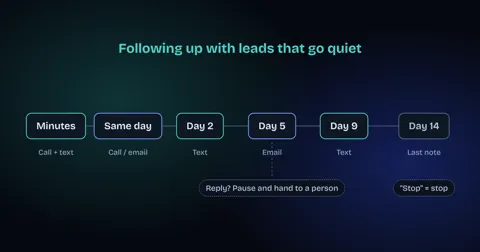
Keep the message short and specific, and make sure a person follows up on every reply. Messaging rules differ by country, so check the ones that apply to you, and always stop texting anyone who asks you to. If a caller still doesn't respond, our guide on how to follow up with leads that don't respond covers a polite two-week schedule.
Fix 4: Cover peak hours and after-hours
Once routing and callbacks are in place, cover the gaps your audit found. There are four common options, and the right one depends on your call volume, budget and how urgent your calls are.
| Option | Works best when | Watch out for |
|---|---|---|
| Voicemail with a fast callback promise | Calls are rarely urgent and volume is low | Many callers won't leave a message, so it only works with a strict callback standard |
| Staff on a rota or on-call phone | You have enough people and calls need expert answers | Burnout, and gaps during holidays and sick days |
| Live answering service | You want a person to answer every call, around the clock | Cost per call or minute, and agents who know little about your business |
| AI call agent | Most calls are routine: booking, hours, prices you publish, basic triage | It needs clear rules, testing, and an easy handoff to a person for anything urgent or sensitive |
Many businesses combine them: an AI call agent or answering service for overflow and after-hours, with urgent calls routed to whoever is on call. Our guide to launching an AI call agent explains how to start small and test before going live. To weigh the two options in detail, see our comparison of an AI receptionist vs answering service.
Fix 5: Give callers another way to reach you
Some callers only phone because it's the only option they can see. A clear contact form, an online booking link and a chat or text option on your website take pressure off the phone, as long as every one of them gets a fast reply.
Put the booking link in your Google Business Profile, your email signature and your voicemail greeting. The aim is not fewer conversations, but fewer customers stuck waiting on hold or for a callback.
Where should a person stay in charge?
Automation can answer, take details, book and send reminders. A person should handle emergencies, upset customers, complaints, pricing exceptions and anything sensitive, such as medical or legal matters.
Write these handoff rules down before you add any answering service or AI agent, and test them with real call recordings or past examples. A caller with a burst pipe or a court deadline should reach a person in minutes, not get a booking link.
How do you measure missed-call results?
Repeat your one-week audit a month after making changes and compare four numbers: missed-call rate, after-hours calls answered, average time to call back, and booked jobs or appointments from phone inquiries.
- Missed-call rate: missed calls divided by total calls.
- Time to callback: from the missed call to your first call or text back.
- Win-back rate: the share of missed callers who still booked.
- Bookings from calls: the number that matters most to your revenue.
Start with the cheapest fix that matches your pattern, measure for a month, then add the next one.
Want this done for you?
We set up call routing, missed-call text-back and AI call agents for service businesses, always with a human handoff for urgent calls. Book a free strategy call and we will look at your call log with you and find the biggest gap first.