How to Grow a Small Business Online: Find and Fix the 5 Leaks Between Search and Sale
How to grow a small business online by fixing the five places you lose customers, from being found to follow-up, and how AI is changing each step.
 By Saad Ali, founder of Agentyra AI
To grow a small business online, most owners reach for more traffic: more ads, more posts, more spend. But growth usually leaks out long before the budget runs out. Customers search, find you, hesitate, reach out, wait, and quietly go elsewhere. This guide walks through the five places small businesses lose customers between the first search and the sale, the simple checks for each, and then how AI is changing both how customers find you and how fast you can respond.
Think of it as a bucket. Pouring in more traffic only helps if the bucket holds water. Fix the leaks first, and every visitor you already get is worth more.
Why do small businesses struggle to grow online?
Most small businesses don't have a demand problem. They have a conversion and follow-up problem: people find them, but something along the way gives those people a reason to choose someone else.
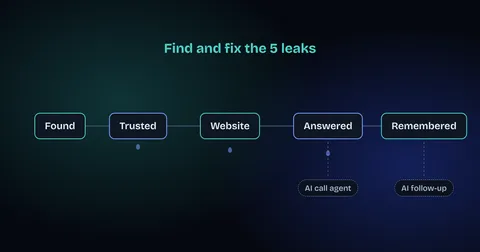
A customer's path usually runs through five steps. They need to find you, trust you, understand what to do next on your website, get an answer when they reach out, and be remembered afterward so they come back and refer others. A weak link at any step loses the customer, no matter how good the work is. Before we built Agentyra, we read 1,171 customer reviews of home-service businesses: the complaint was rarely the work itself. It was silence.
Leak 1: Can customers find you?
If customers can't find you when they search for what you do, nothing else matters. The fix starts with your Google Business Profile, consistent business details and a website with one clear page per service.
- Complete your Google Business Profile. Categories, services, hours, photos and a description in plain language. Post updates occasionally so it looks alive.
- Keep your details identical everywhere. Your business name, phone and address should match on your website, profile and directory listings.
- Give every service its own page. A page about "kitchen remodeling" can rank for kitchen remodeling. A single "Services" page that lists ten things rarely ranks for any of them.
Search engine optimization is the long-term version of this work. Our SEO and AI search visibility service covers it in depth.
Leak 2: Do people trust you when they find you?
Being found is only half the job. Before they contact you, most people check your reviews, and a thin, old or unanswered review profile sends them to a competitor.
BrightLocal's 2026 Local Consumer Review Survey of 1,002 adult consumers found that 97% read reviews for local businesses, 47% won't use a business with fewer than 20 reviews, 74% look for reviews written in the last three months, and 89% expect business owners to respond to reviews.
- Ask every happy customer for a review, right after the job, with a direct link. Most people will leave one if you make it easy.
- Keep reviews recent. A steady trickle beats a burst from two years ago.
- Reply to every review, good and bad. A calm, helpful reply to a complaint often builds more trust than a five-star review.
Leak 3: Does your website make the next step obvious?
Your website's job is to turn a visitor into an inquiry. If someone has to hunt for your phone number, guess what you charge or wonder whether you serve them, many will leave.
- Say what you do and who it's for in the first screen. No slogans that need decoding.
- Put one clear next step on every page, such as "Book a call" or "Get a quote", and repeat it at the end.
- Make it fast and easy on a phone, where many customers will first see it.
- Answer the obvious questions: how pricing works, what happens after someone gets in touch, and how long things take.
If your site was built years ago and never revisited, a rebuild around these basics can do more than any new campaign. That's what our website development work focuses on.
Leak 4: Does anyone answer when customers reach out?
This is the most expensive leak, because it loses people who have already decided to contact you. A missed call or a slow reply to a web form often ends the conversation.
CallRail's 2025 small business benchmark report found that healthcare businesses miss 32% of their calls, legal firms 28% and home services 14%, and that up to 85% of callers whose call goes unanswered will not call back. Web inquiries go cold just as fast: people contact several businesses at once and usually go with the first credible reply.
- Track how fast you reply to calls, forms and messages for one week. Most owners are surprised.
- Cover the gaps: lunch, evenings, weekends and the hours when everyone is on a job.
- Reply to every inquiry with a clear next step, such as two appointment times, not just "we'll get back to you".
Our guide to how to automate lead follow-up explains why response time decides who wins the customer, and our AI answering service for plumbers page shows what full call coverage looks like for a trade business.
Leak 5: Do customers come back and refer others?
Often the easiest customer to win is one you already have. Yet many small businesses never contact a customer again after the invoice is paid, and lose repeat work and referrals to whoever stays in touch.
- Follow up after every job: a thank-you, a review request and a simple "anything else we can help with?".
- Send useful reminders, such as a service due, a renewal or a seasonal check, rather than generic newsletters.
- Make referring easy: a short message customers can forward, or a thank-you for every referral.
How do you check your business for leaks?
Run a quick five-leak check: look at each step as a customer would, note the symptom, and fix the biggest leak first. The table below gives a check you can do in an afternoon.
| Leak | Symptom | Quick check | First fix |
|---|---|---|---|
| 1. Found | Few calls or visits from search | Search for your main service and town in a private window | Complete your Google Business Profile; one page per service |
| 2. Trusted | People find you but don't get in touch | Count your reviews from the last three months | Ask every happy customer for a review; reply to all |
| 3. Website | Visitors leave without contacting you | Open your site on a phone and time how long it takes to find how to book | One clear next step on every page |
| 4. Answered | Inquiries that never turn into jobs | Count missed calls and unanswered forms for a week | Cover after-hours and busy times; reply with times, not promises |
| 5. Remembered | Few repeat customers or referrals | Check when you last contacted past customers | A follow-up after every job and useful reminders |
Everything so far works without any AI. But two things have changed recently: how customers search, and how much of this work software can now do for you.
How is AI changing the way customers find businesses?
Customers increasingly ask AI tools for recommendations instead of scrolling through search results. In the same BrightLocal survey, use of AI tools for local business recommendations rose from 6% to 45% in a year, making them the third most popular source of recommendations, and 82% of consumers read AI-generated review summaries.
That raises the stakes on leaks 1 and 2. AI answers are built from what is already written about you online: your website, your Google Business Profile and your reviews. Google says there is no secret trick for its AI features. In its guidance on AI features, it states: "There are no additional requirements to appear in AI Overviews or AI Mode, nor other special optimizations necessary."
In practice, the businesses AI recommends are the ones with clear service pages, consistent details and plenty of recent, answered reviews: the same fundamentals as above, done properly. Our article on SEO for AI search covers what to change on your website.
How can AI plug the leaks in your business?
AI is most useful on the leaks that depend on someone being available: answering, following up and staying in touch. These are the jobs owners know matter but rarely have time to do every single time.
| Leak | Done by hand | With AI |
|---|---|---|
| 1. Found | Writing pages and profile posts when you have time | AI drafts service pages, posts and descriptions for you to check and publish |
| 2. Trusted | Remembering to ask for reviews and reply | Automatic review requests after each job; AI-drafted replies you approve |
| 3. Website | A contact form someone checks later | A chat or support agent that answers questions and books the visitor in |
| 4. Answered | Calling back when you're free | An AI call agent answers every call and automated lead follow-up replies to forms in seconds |
| 5. Remembered | Occasional catch-up emails | Reminders and check-ins sent on schedule, with replies routed to your team |
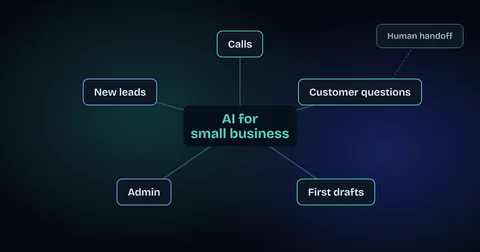
The rule that makes this work: AI handles the routine, people handle the judgment. Every agent should know when to hand the conversation to a person, such as an upset customer, an unusual request or anything sensitive. Our guide to AI for small business covers how to choose tools and roll them out one step at a time.
Where should you start?
Start with the leak that loses customers who have already chosen you: unanswered calls and slow replies. It is the easiest to measure and usually the fastest to pay back. Then work backwards through trust, your website and being found.
- Run the five-leak check from the table above this week.
- Fix the biggest leak by hand first, so you know what "good" looks like.
- Bring in AI where the fix depends on someone always being available.
- Measure for a month, then move to the next leak.
That is how we work at Agentyra as a growth studio: websites, SEO and marketing to get you found and trusted, and AI agents to make sure every customer who reaches out gets an answer. If you'd like a second pair of eyes on where your business is leaking, a free strategy call will give you an honest answer.